When We Are, What We Aren't
“How has writing developed within you throughout your life?”

In late October someone asked my writing course group, “How has writing developed within you throughout your life?” In the weeks since, I’ve tried in stop-start-stall attempts to honour my persistent suspicion that a writer’s not only one-who but may also take the shape (pray temporarily) of a person who suffers instead. Far from a #woke appeal to the power of self-identification, the following experiences described are for those acting against an inevitability; not to suggest all who write are necessarily compelled to but simply to say that, just maybe, not all who don’t, aren’t.
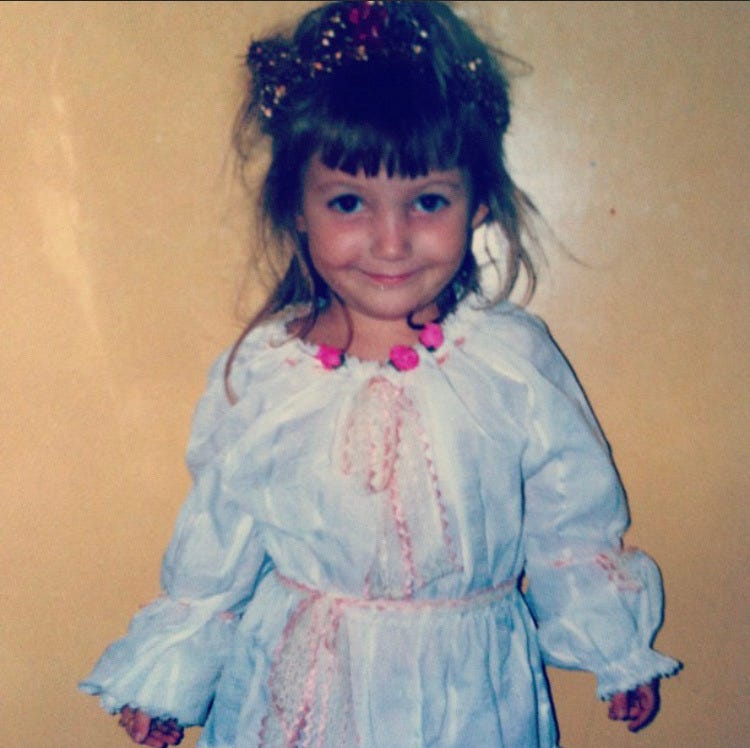
In first grade, a child smaller than most of age wrote a crawling Love Letter to a boy in class she’d never spoken to. See her. She’s sealing the note with a sense of communion, propping the object proudly upon a desk by the foot of her single bed while a rising sun refracts green and reds through the stained-glass window, cast lengthways along a darkly varnished floor. She’s being sent away for the day, but spins smiling toward it.
Blurring back into position, the taste of dry gum is summoned to her tongue at the sight of the letter's mouth open between a set of callused fingers. One glance of disbelief toward the barren desk then back at its solid four edges broken into five: the confession possessed by her father and sneering cousin. Something moving inside wrestles itself at her centre, a deluge, flood of anger. We’d call it betrayal; she’d call it shrinking.
These sensations and shame mixing—blood-cheek-staining—taking ownership of the body once virgin to the cocktail. First hope then doubt fades; kissy faces made, they’re chanting the name, chanting the name, chanting the name. A fruitless swipe, and dash down the dirt-grass trail beside this rental house in the middle of town ensues.
The girl is running down the nature-strip adjacent her neighbour’s. Oh-livia’s the image of one hundred diamond shaped pieces. A child cross-hatched head-to-toe in thin grey lines as if under a spell of protection. Together they play only from respective sides of the fence. Oh instructs with authority while the girl muddies her hands mixing dirt, water and bracken into Mother's big cast-iron pot in an act of witchcraft. Olivia’s mother wore buttons, their door and windows sealed at night and her daughter’s name was not Uh-livia, rather; Oh: the correction immediately clocked when parsed. The only time she glimpses the contents of their house is from outside. Floor polished clean, perfectly middled table ornaments, no sign of primary coloured scraps, their furniture covered in plastic (but she’s tugging on my sleeve, whispering may have made up that bit).
No sign of the Cauldron as she runs faster, as if through time for retrieval toward the mocking echoes of a laughing thief. Booming voices shout, "SURPRISE!" It's Laura’s birthday. Head and body frigid, her eyes scan as the backyard loads into an expectant audience of teeth. A party. Diabolical. She starts crying. Unveiled is the bicycle-shaped sheet from the spare room—tasselled handlebars and all. She’ll never learn to ride this bike and upon its return, Laura wets the letter salty and destroys it.
Part of me—the thing slumped over inside still saps from the feeding tube of this memory before positing myself within the mind of my father then early-twenties thinking love letters in general silly; all this probably very cute.
Thankfully, by age six the creator saw fit to slot a red-haired Rebecca into the coveted position of my best friend. In those days, a kid might eat nothing but Maggie noodles and dry crackers to the worst-case accusation of: picky. My only memories of discord between us were times she’d gained uncharacteristic access to that vital thing inside that says “No.”
I’d no conscious interest in dictating her actions, but have audited with horror the times I didn’t like them:
If she becomes mean, she’ll no longer need me!
One day in a Tuckshop line, a tall girl in the grade below us picked on my height and Beck turned asserting, “UM, ACTUALLY —” and to great prevailing shame, I struck my friend. What kind of organisation at age ten did I think I was heading? Or at nineteen when she asked a coworker to stop sucking at a steaming, stinky handful of roast chicken in the elevator then returned home with the news. Will the world see no end to Becky’s reign of terror? After lunch, I cried outside our fifth-grade classroom refusing to enter while others relayed the situation to the teacher. He knocked our washboard bodies against one other as if mere dominoes loosely magnetised at the base and we made up. Beck and I’ve rarely hugged. To my relief, she didn’t long treat me with caution, I believed we’d remain one another’s primary confidante forever.
“How was school?”
“Shit” if fine, “Fine” if awful.
Disappearing into fictional realms, Nan gasps at the sight for size of my novels. Kindly strokes and lashes both scar the internal database. Aside from one story where the protagonist wakes at the end, I scarcely marry pen to paper unless directed.
Speech writing, grade six: the faculty judge the top three qualifiers for an interschool public speaking competition. My personal exposé makes the cut, as does Beck’s stand against the fur trade. Together we practise before a small group of school captains and the chronically red-faced Principal, Mr. Hatcher. Though having steeled myself for when “…the dog lifts his bloody he—,” no sooner than the word had escaped I’d burst uncontrollably—my friend half-smiling side eyed as the group glared daggers. Rebecca had been pre-warned; the diplomatic usage of the word “bloody” by T.V. legend Alf Stewart undermined any explicit power about it. Next time, maybe I’d read first—talk about a tough crowd.
“What’s with the big words?” father mocks over the dinner table. For years we bicker. I taunt, the belt cracks and doors slam. Decades later, a psychologist will suggest this was my way of bonding with the man.
On the night of the event, kids spoke into their crumpled print-outs while I showboated having memorised mine through rhythmic repetition. As for the topics, the others urged adults to change stuff—stop being cruel, fucking up the planet and doing war.
I’d essentially come to brag about becoming a sister.
Verbally reorganising words from a textbook, Will strains in the next seat over stammering between compelling attempts and nervous laughter. Glancing up, he’d search the stone face for a shred of mercy—find none and stare lost at the page repeating the process. I slide a finger below each line while he sounds out the words and eventually the ordeal ends. “I have dyslexia.” Interesting.
A sense of respect for something settles here. I’m twelve, realising Will can’t read and that it’s not his fault. I can, maybe it’s got nothing to do with me, either.
When mum returns home with a laptop computer, I sit on the edge of my bed staring at an empty Word document as the cursor blinks thinking, ‘I could write a novel…’ then flip it closed with nothing to say.
My friend had moved to a village populated by less than three-hundred. We correspond during any class with computers and I stay over holidays; buying Paddle Pops and swimming nude in Lake Cootharaba. At the beginning of each high school semester, my schemes to exceed expectations and hone focus are broken. Fading too is the vision: first to attend University...
In Sociology, the girl pores over graphic depictions of “Bystander Apathy” wondering whether she’d too howl if raised by wolves… When an Early Childhood educator raises concern about marks on the student’s wrist she responds to sincerity with—emotional intelligence limited. Assessment; only recourse: face contortion, sarcastic retort, authentic display of annoyance. During every class she’s distracted by things like the scent of a teacher’s perfume, the football player dumping her again for a girl who’ll put out and whether Tane cheated on Marnie and who with, honourable mention to the Biology teacher’s menopausal sweat. The Physics teacher hadn’t said boo from the beginning—which she amended through imagination… oh no, I’m stuck in the supply cage with this balding, pale, preposterously-tall and bespectacled man by clumsy mishap… or through stern disciplinary action?
"YOU’LL REGRET THIS FOR THE REST OF YOUR LIFE!"
Rachael was tall and stiff and talked a lot. She seemed lax with an unaltered uniform yet glid casually between established groups in high school. Maybe she played tennis. A peculiar overlap socially was granted studious girls also in some way athletically impressive—I’d determined, sorting people as if correct allocation determined survival. Rachael had cropped her long, grey-brown hair short in this final year, the bridge of her nose led seamlessly into her forehead much the way mine would at thirty if not for… Frowning now, her outburst astounded me then—she’d feared for my soul and we'd, like, never spoken.
Did it feel any different driving home as an English teacher that day? Had it been a bad one or relief? One less poor statistic reflecting, I’d thought, handing coffee out a sliding window months later to little acknowledgement. Had she seen through my struggle to maintain eye contact—sensed all her student saw staring back was a grotesque reptilian creature who'd learned to point and string words together? The Alligator: her sharp monosyllabic name, nose, cheekbones, cold lidless eyes and narrow elbows. I’d scowled during a slideshow presentation of herself and daughter clad in snowboarding gear smiling. Any suggestion that a warm maternal person lived inside rendered null-and-void.
Three years prior she’d taught Film and TV. One day alone in the back row as per usual, two tattooed Mouri cousins sat either side and reached between my legs. Wearing a pad that day, all they'd felt was a barrier but the pang of embarrassment ahead made me wish it weren’t there for in sliding forward to give less leverage and reach, one of them commented "that feels mean.” Mean didn’t necessarily mean bad, but didn’t inspire confidence, either.
“Where’s your assignment?”
Now fluently petulant, “I’m thinking about dropping out, anyway.”
“Then go to office. Fill out the form. Leave.”
It felt a bigger betrayal of self in that instant to allow the creature call my bluff before the entire class than it did to palm-slide a by now doomed fantasy of life in academia from desk to floor forever. Besides, I still had my lucrative afternoon job. While gathering my things, Rachael threw that last-ditch caution across the room which I absorbed as both poison and fuel. With any hint at latent ability or ambition brushed aside, by year’s end donned in a cap and headset, I was handing soft-serve cones to the happy graduates.
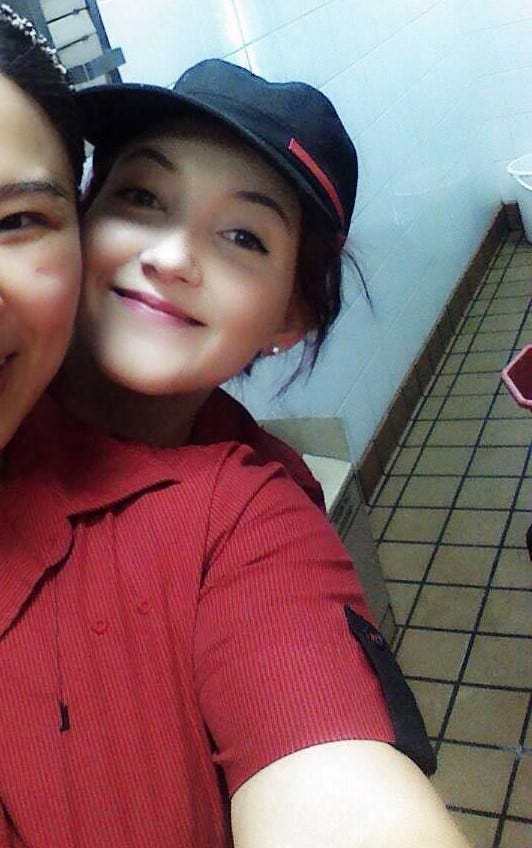
Beck and I rented an apartment up a steep flight of stairs in Brisbane’s West End. We worked shifts, attended gigs, tread on blue carpet torn up in places and washed our laundry in the bathtub to avoid neighbours. To varying degrees and results I’m insane with no way to face it. Meanwhile the pile of biographies of authors, killers, musicians, poets, comedians, war heroes, spiritual seekers, climbers, athletes rises along with the classics.
By early twenties, in-between a string of service jobs, I find myself in suburbia with a boyfriend. One night he sits me up on the kitchen bench and says, “You should be a writer. it’s obvious you want to.” Interesting. How’d he know that? The only external points of proof were hardly solid: thought-streams over Tumblr since age sixteen, my private prolific use of the Notes app, lengthy Instagram captions and snobbish underlining of in-print typos. As for visible signs of a soul in crisis, those were attributed to more logical things, like being fucking broke.
An acquaintance says, “Hey, you should look at this,”—it’s the blog of a young girl who'd been copying and reposting my ruminations for months making negligible alterations. Interesting. Writing’s the only practise dually lost-and-found in, but still I’d held no leash on the practise, moving through the world as an untuned instrument… or EMI personified.
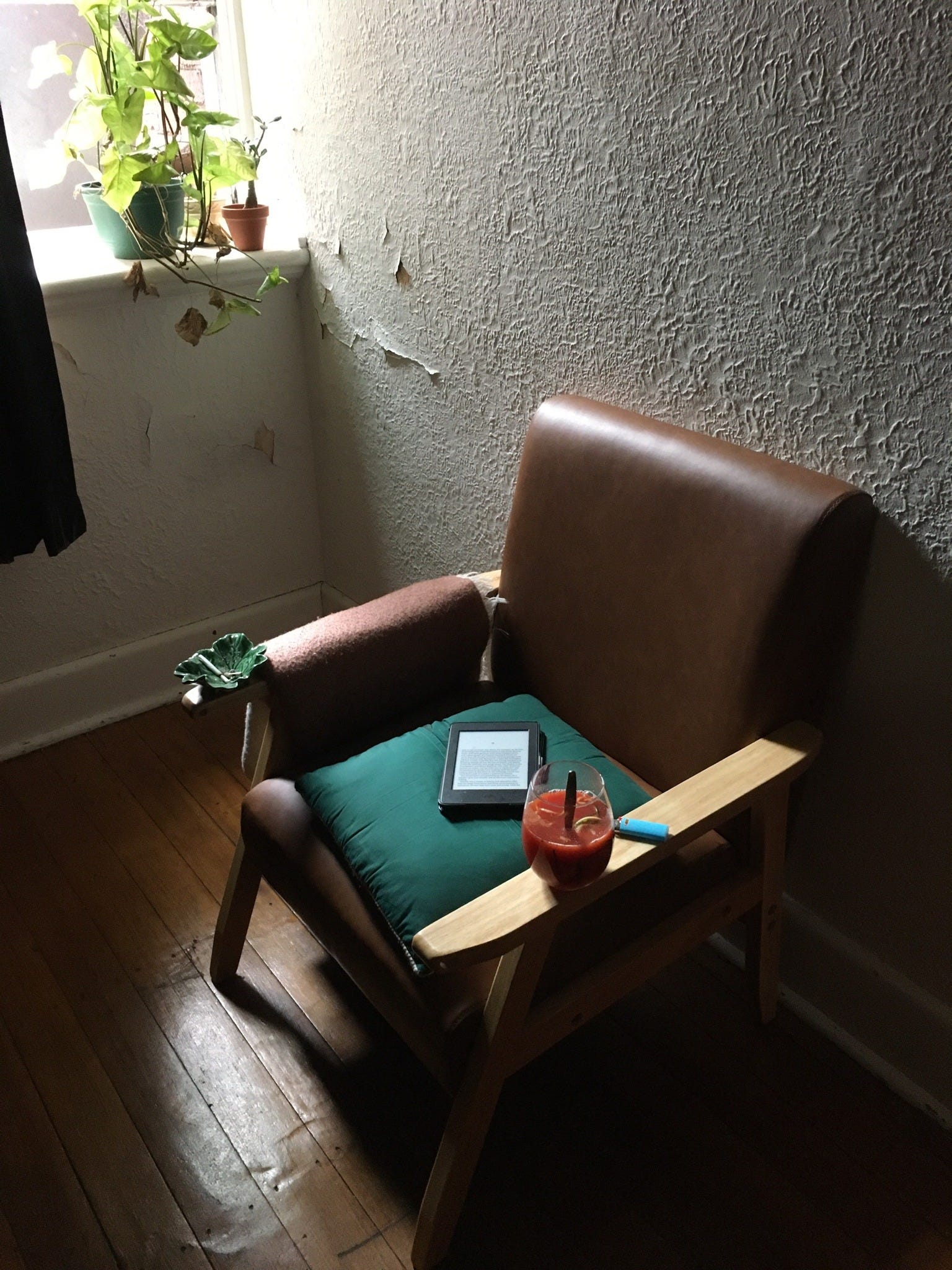
The big city wasn’t big enough, nor far enough way. at twenty-six, I relocated to Melbourne City and worked as a check-out girl with one an ear cocked to Woolworth’s Radio’s rotating playlist. Soon it would cycle back to Fast Car. Good. Tracy gets it. Scanning items at the register sweating beneath a black sweater covering the logo in summer, consolation comes from the prospect of mature-aged study. Arts, Writing—people here even became Philosophers. In lead pencil across my brain, “you’ll regret this for the rest of your…”—beep—unfortunately—beep—Rachael had kinda been... Every time I consider what studying writing might look like, a brutal inner voice mistaken for wisdom parses; writing? as a job? Ridiculous. It’s a profession based on what’s not there!—Beep. I’m only looking out for your best interest!
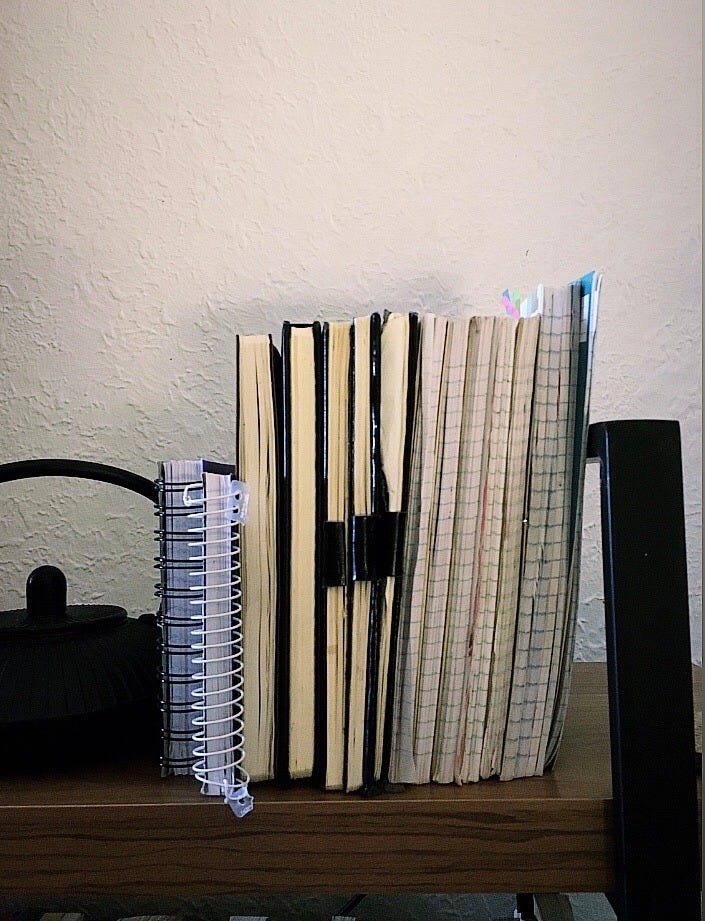
Share-housing with a rotating cast of characters, I stack black leatherbound journals in plain sight on a bedroom shelf and write to reflect on mundane days, thoughts, goals and single-girl escapades with neither prospect nor intent of settling until... him. He’s been complaining of illness for weeks from the mould in his share house, and my devious mind plots. It’s March 2020.
Diary entry: Venues with a cap of 500, 200, 100 then 50, 25, 15 individual human beings, anti-socially spaced. Sunday it was announced that non-essential services were to close by midday Monday. Jobs gone: just gone. This city is built on stolen land and the creative drive of 4.9 million people. All during the bush fires – which are probably still burning but we’ve forgotten – these music venues funded relief efforts. I hope the importance of creators and those who facilitate them are not forgotten now. To create is to summon God. Sunday night I went to my favourite vegan restaurant, the owner was grinning; he’d bought a cage to install over the door while they’re closed. Told us some travellers are committing petty crime for the chance at deportation to their home countries. I recall road trips with my mother, rating each house we’d pass for their overall stability in a post-apocalyptic society. Caged windows were always big point scorers. One of my housemates is without work now, the brothel closed and she’s clearing her room tonight. After today, another of my housemates is without work too. That’s two out of four. Mum said to stockpile food in a box beneath my bed. [Housemate] says this will all blow over in a couple weeks.
With her head on his chest he calls her “inner-circle,” tracing some place on her body while narrating his life. She finds this pensive, streetwise Artist’s past mischief endearing. The guy with whom she’d bonded many months over Rock'n'roll, Buddhist principles and self-betterment; who’d stated weeks prior—out of the blue, as if she’d been obvious—that nothing would ever occur between the two was now in her bedroom daily, sketching the body of a swallow in her notebook and writing her name in cursive below.
“Don’t tell him.” A friend says.
“I will, but is now too soon? it feels presumptuous.”
Within days of being set straight about our status as friends, I did the only thing reasonable and slept with one of his. The friend had at least made an impression by groping, picking up and over-powering me mere hours after meeting and now the two men were on the outs over some unrelated squabble. Truth be told, I prefer being small and tossaroundable, but his firm grip unsettled me. Adding insult, all efforts on my part to signal discomfort went unnoticed. The acquaintance cooled down later talking literature, recommending Down and Out in Paris and London before plucking another novel free from its wedged spot, handing it over.
Opening to the dedication, it simply read, For Laura. This was a brand of kismet I’ll fall for every time. He’d seemed surprised too, hadn’t he? Glancing over, the crush still showing no hint of possession. Time makes one question. It took years to develop enough cynicism to reassess all the bed roughhousing then; one tossing pillows and cushions and blankets upon the other, elbow slamming, laughing and beckoning me over. I’d laughed them off, thumb still caressing the flat text of kismet. Had the girl been where destined? exploring a burgeoning connection with a radically sexually open new friend and the man who’d hopefully, eventually come to write her name in cursive below a symbol of new beginnings? Yes, the night stamped with undeniable care, For Laura.
The glare of possession now present, he riffles through journals, her phone and recites lines from before they'd met; questioning what was meant by whatever written or said. Says about her his head, heart, gut say yes yet is certain she's a liar and whore—no attempt to reach mutual comprehension matters. Interesting. Erasure of the past is a power she does not possess; tears up in vain all penned accounts no matter harrowing, beautiful, dull into a garbage bag she’ll dump outside after work. Returns home to it open, braces for the fight and prays for a purified mind. He tears apart the bed in anger, days later using its boards to frame a new painting he calls, “A Fresh Perspective” and sells on Marketplace. The housemates separate, the new couple move to a humble flat in Balaclava, where the man cracks open her inner nest-egg of creativity, method be damned—and she’s grateful, angry, grateful…
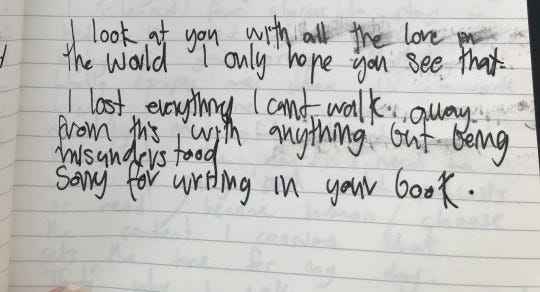
With the hinges on a closed door broken again I’d resigned to solitude and leaned into writing, the only task of solace while the Victorian Government dipped its population beneath and above then beneath water again.
Diary entry. 21-09-2021. We’re out of lockdown in less than two and a half hours, midnight Friday. It’s 10:30PM, our curfew was 9PM.. So basically it’s this futile final three hour curfew period before we can all just wander outside, no questions. At least one bar is opening at midnight. Chapel was gently awakening, I sat and watch it stir; didn’t feel separate from the atmosphere like I have the five prior lockdown endings. At first I felt dread—know it’s wrong but love to be alone; alone with locals. I watched staff sanding back tables, assembling marquees and letting mop water run out onto the sidewalk. A year and a half ago we weren’t sure how long this would last. Now we’re here and it feels like resuming mid-scene, post-intermission. I saw the man who sits outside 7/11 on his crate bend and resume his exact position, then passed by a tradie whose colleague broke through on the walkie, “no one should be out after nine anyway, it’s still technically lockdown” I sat in the park in darkness surrounded by people doing the exact same thing. Waiting.
I did not—couldn’t hold back this thing lain dormant. Mother phoned having run into my first-grade teacher in town. She’d asked, “Is Laura still writing?” Memories flood from Mrs. Summer's class: staring at alphabet cards on the wall, complaining the curve at the end of lower-case a’s an unnecessary labour, taking guard during recess while Becky ate banned chocolate biscuits and glimpsing the willy of a blond boy—the subject of the sacred letter.
Everything that’s ever happened has been painstakingly integrated as signs or blessings in disguise that served to trigger the most prolific, albeit—let me be clear—amateur writing years of my life so far.
Around the time of that phone call with mum, I’d heard something Liz Gilbert said to profound effect in that it was entirely unrelatable: her writing practise was the one consistent thing—the one area of her life she’d never, ever betrayed.
Deeply inlaid coding screams “you’ll never be anything” but over the last four years I’ve written to resolve this, it’s a work in progress done in public—a credit in some way to the strange violating, liberating lesson about openness from my fifth-grade teacher written about here.
It’s a strange thing, even personal revolution depends upon a kind of violence. Old wounds heal over, new ones take—well not longer, but significantly more attention.
The hands of my farm labouring father soften with a professional transition into the humanities, our phone calls traverse the years before I was born and regret’s expressed over things he wished he’d done better. In sharing bits and pieces of writing over Facebook (pushing through the cringe) he reaches out to double-check they’d really been written by me. Asks why I never came home with certain stories, like the one about the boys violating my body in class and says I’m a good little writer without belittling intent. This thing having clawed at my insides for years is finally heard and allowed to stretch out and writing no longer feels like a thing “not-there” if that makes sense.
A couple months ago I joined an online writing course and when the teacher said, “Welcome to writing school, Laura!” it was as if he’d poured holy water over the coals in my gut. At thirty, I’m diagnosed with ADHD which emboldens me to let go of all shame over having struggled through academia as a clueless child perched in the dark corner of every room.
Credit to mentors not mentioned, signs and events not listed and the many days, nights of droning, dead to rights boredom great writers have driven themselves mad attempting to outline. The noun of it all’s far from lost on me, but there’s no clearer way to explain than hopefully I have that regardless of output and for as long as memory serves: I was what I wasn’t. It’s easy to internalise the fear and careless behavior of others, to blame circumstance but to what end? It’s our job to reclaim our voice. Maybe I’ll never pen a brilliant work of fiction; so far it’s certainly not where my strength lies nor is the idea as thrilling to me as the transmogrification of mundane details of daily existence—and maybe that’s alright. Some say writers are made, developed or born; whatever, if any of this resonates: do the fucking thing, or don’t and suffer. The suffering exists either side of your practise—certainly inside it—but the noun won’t go nowhere; fights tooth and nail to live so team up or fall prey to it. I honestly believe those are the options. A writer not writing is no joy to know. I also believe writing is a sexually-transmitted disease but let’s fucking wrap this up.
“I never promised the universe that I would write brilliantly; I only promised the universe that I would write.” — Liz Gilbert